


Ads in ChatGPT. Monetizing the Machine.
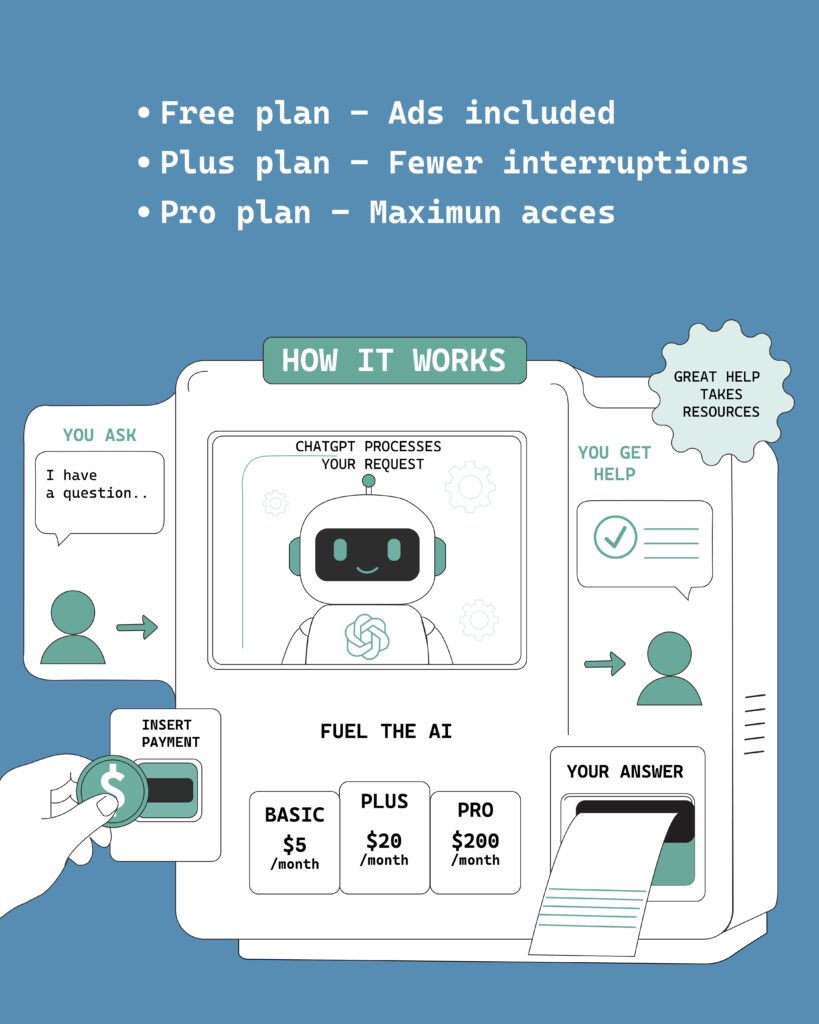
In early February 2026, OpenAI began rolling out advertisements inside ChatGPT, marking a notable shift from the service’s long-standing ad-free experience. The move has sparked discussion about the future of conversational AI and how such systems will be funded as their use expands. According to multiple reports, OpenAI has started testing ads with users in the United States who are on the Free tier and the recently introduced ChatGPT Go subscription, a lower-cost plan priced at around $8 per month.
These sponsored messages appear at the end of the AI assistant’s responses and are clearly labeled as advertisements. OpenAI describes this format as a way to support broader access to its technology while maintaining strong performance for free and lower-cost users. The company has emphasized that ads do not influence the model’s answers and that conversations remain private from advertisers. [source 1] [source 2]
Early reporting suggests that OpenAI’s advertising pilot relies on conversational context rather than traditional banner placements. Ads are matched to the topic of a user’s query instead of appearing as generic promotions.
For example, a user asking about travel might see a tourism-related advertisement, while someone discussing productivity tools might encounter a sponsored software recommendation. According to OpenAI, advertisers do not receive access to individual conversations. Instead, they see only aggregate performance metrics such as impressions or clicks.
The company has also placed restrictions on where ads can appear. Users under 18 should not see them, and advertisements are excluded from certain sensitive topics, including health, mental health, and politics. [source 1] [source 2]
The introduction of ads also reflects a new distinction between ChatGPT’s subscription tiers. Under the current structure, ChatGPT Plus, Pro, Business, Enterprise, and Education subscribers remain ad-free. Advertising is limited to the Free and ChatGPT Go tiers.
Some reporting suggests that users on the Free plan may eventually be able to turn off ads in exchange for lower usage limits, though the details of this option remain unclear. These distinctions highlight a broader trade-off between monetization and user experience. Users who pay higher subscription fees receive an uninterrupted interface, while others effectively subsidize their access through exposure to advertising.
From a business perspective, this approach positions ChatGPT not only as a software tool but also as a platform with a monetizable audience. [source 1] [source 2]
The introduction of advertising is widely viewed as a response to the immense costs associated with developing and operating large AI systems. Running models at global scale requires vast computing infrastructure, expensive data centers, and continuous investment in research and engineering.
Although OpenAI generates substantial revenue through subscriptions and enterprise partnerships, analysts note that the costs of training and deploying advanced AI models remain extremely high. Industry estimates suggest that the company may still face multi-billion-dollar losses in the near term as it continues investing heavily in infrastructure and model development. [source]
This economic reality helps explain why advertising is being explored despite earlier hesitation from OpenAI leadership. CEO Sam Altman previously described advertising as a “last resort,” but the scale of investment required for modern AI systems has pushed the company to consider additional revenue streams. With hundreds of millions of users on free plans and only a fraction paying for premium access, advertising offers a familiar way to capture value from a large and highly engaged audience.
OpenAI maintains that ads will remain clearly labeled and separate from the assistant’s responses, positioning them as a pragmatic funding mechanism rather than a core feature of the product. [source]

Beyond the practical business considerations, the introduction of advertising into ChatGPT raises broader questions about attention and the nature of digital information spaces.
Critical theorists have long argued that modern digital economies commodify attention itself. Platforms transform moments of focus into resources that can be bought and sold. Conversational AI introduces a new environment for this process. When users interact with an AI assistant, they enter an information space that feels personalized, responsive, and often intimate.
Introducing advertising into that space subtly changes the character of the interaction. Even when clearly labeled, advertisements become part of the user’s interpretive environment. They shape what the user sees and how the experience is framed.
This shift raises a deeper question: can a conversational AI remain a neutral partner in inquiry when it also serves as a vehicle for commercial messaging? [source 1] [source 2] [source 3]
Advertising also affects how users interpret the assistant’s guidance. Autonomy in digital systems is not only about having choices; it also involves understanding the conditions under which those choices are presented.
OpenAI’s decision to clearly label advertisements and keep them separate from responses can be seen as an attempt to preserve that autonomy. Yet the presence of ads introduces a new form of uncertainty. Users may begin to wonder whether recommendations are purely informational or indirectly shaped by commercial incentives.
This concern becomes more significant as people increasingly rely on AI assistants for everyday tasks. Someone might ask for help choosing a budgeting app, comparing productivity software, or understanding medication instructions. In these situations, even a clearly labeled advertisement could influence attention toward a sponsored product, regardless of whether it is the best option.
The ethical concern is not necessarily that the system provides false information. Rather, it is that a conversational environment that feels neutral and informational begins to take on commercial characteristics. The user is no longer only a person seeking knowledge, but also a potential customer within a marketplace. [source 1] [source 2]
As AI assistants become more embedded in daily life, the way they are funded becomes an increasingly important question. Tools like ChatGPT are starting to function as digital infrastructure used for education, work, creativity, and everyday decision-making.
This raises broader normative questions. Should foundational AI tools remain accessible without commercial pressure, similar to public infrastructure? Or is advertising a reasonable mechanism for subsidizing access while allowing companies to sustain expensive technological development?
The answer is not purely technological. It reflects deeper choices about how society wants to structure digital knowledge systems, how public goods should be funded, and where the boundaries between information and commerce should lie.

As conversational AI continues to evolve, those choices may shape not only the business models of technology companies, but also the nature of trust and inquiry in the digital age.