
After the UK’s “age-checked internet,” Europe is lining up next
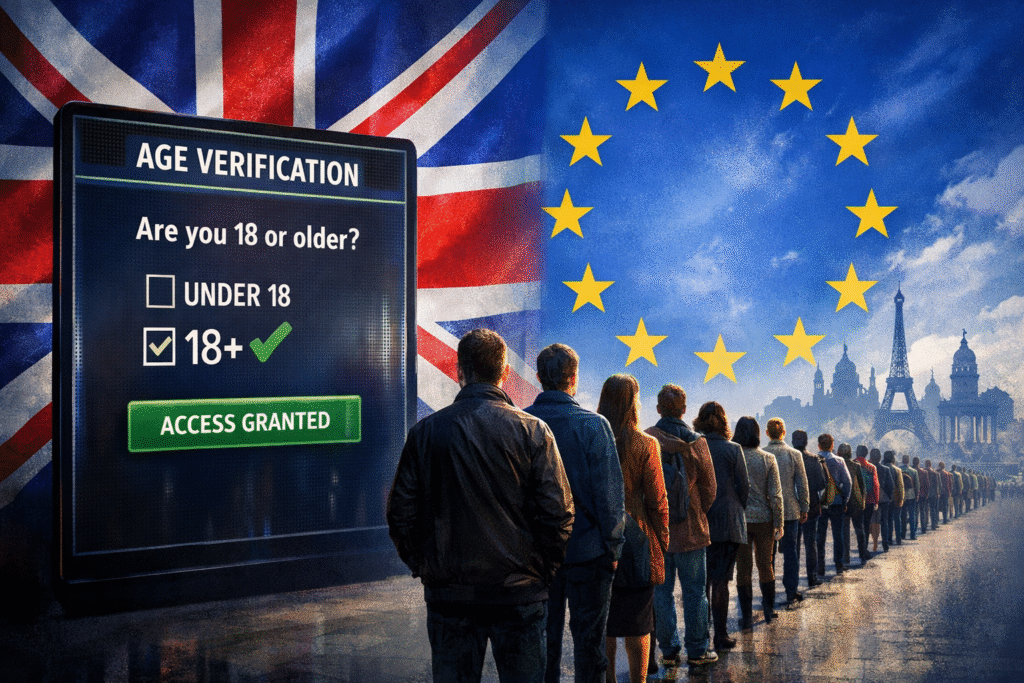
For most of the internet’s history, access to online pornography was governed by a ritual: the checkbox. “I am over 18.” A small lie (or a small truth) that carried the weight of a boundary.
The UK has now replaced that ritual with something harsher and more real: infrastructure. Under the Online Safety Act, Ofcom’s regime requires porn services to deploy “highly effective age assurance” so that children are not “normally able” to encounter pornography, with key duties coming into force in 2025 and a major compliance moment on 25 July 2025 for services that allow pornography. [source 1][source 2][source 3]
That shift matters beyond Britain because it reveals the direction of travel: Europe is moving from “law on paper” to “law on the screen.” And the countries most clearly preparing to follow the UK into practical enforcement are France and Italy, with Spain advancing legislation that can plausibly support similar outcomes, under growing EU-level pressure and tooling.
What follows is a Europe-only, porn-specific map of what’s coming, grounded in official sources.
What “UK-style enforcement” actually means
“Enforcement stage” isn’t just passing a statute. It’s when regulators can realistically compel outcomes like:
• Hard age-gates (effective age verification/assurance before access), or
• Business disruption (blocking/delisting) for non-compliance.
In the UK, Ofcom’s official guidance makes the duty explicit: providers that publish pornographic content must use age verification or other highly effective age assurance to keep under-18s out, and Ofcom has communicated deadlines and expectations directly to in-scope services. [source 1][source 2][source 3]
This is the “age-checked internet” model: the boundary becomes technical and enforced, not merely declared.

France: from legal obligation to real blocking powers
France is the clearest EU case of a country trying to operationalize porn age verification at scale.
France’s regulator Arcom states plainly that the SREN law (21 May 2024) gave it the power to sanction and administratively block pornographic websites that don’t comply with the obligation to prevent minors from accessing porn. [source 1]
Arcom has also published official guidance on age verification for pornographic sites (the “how,” not just the “must”). [source 1][source 2]
France is not merely “planning.” It is already using the enforcement staircase that leads to UK-style outcomes:
• formal steps targeting non-compliant porn platforms,
• powers to block (for limited durations, reviewable when compliance changes), as Arcom describes.
[source]
France has also issued a ministerial order designating pornographic sites established in another EU member state that are subject to France’s age-check obligation, showing that the government is actively preparing cross-border enforcement mechanisms, not just domestic compliance. [source 1][source 2]
France’s design choice is revealing that it wants a world where a person can remain anonymous, but not unverified. In political terms, it’s trying to separate:
• identity (“Who are you?”) from
• status (“Are you an adult?”)
That’s a very European move: the state isn’t seeking confession, but classification.
Italy: a declared enforcement date and a formal compliance regime
Italy’s trajectory looks even more like a timetable.
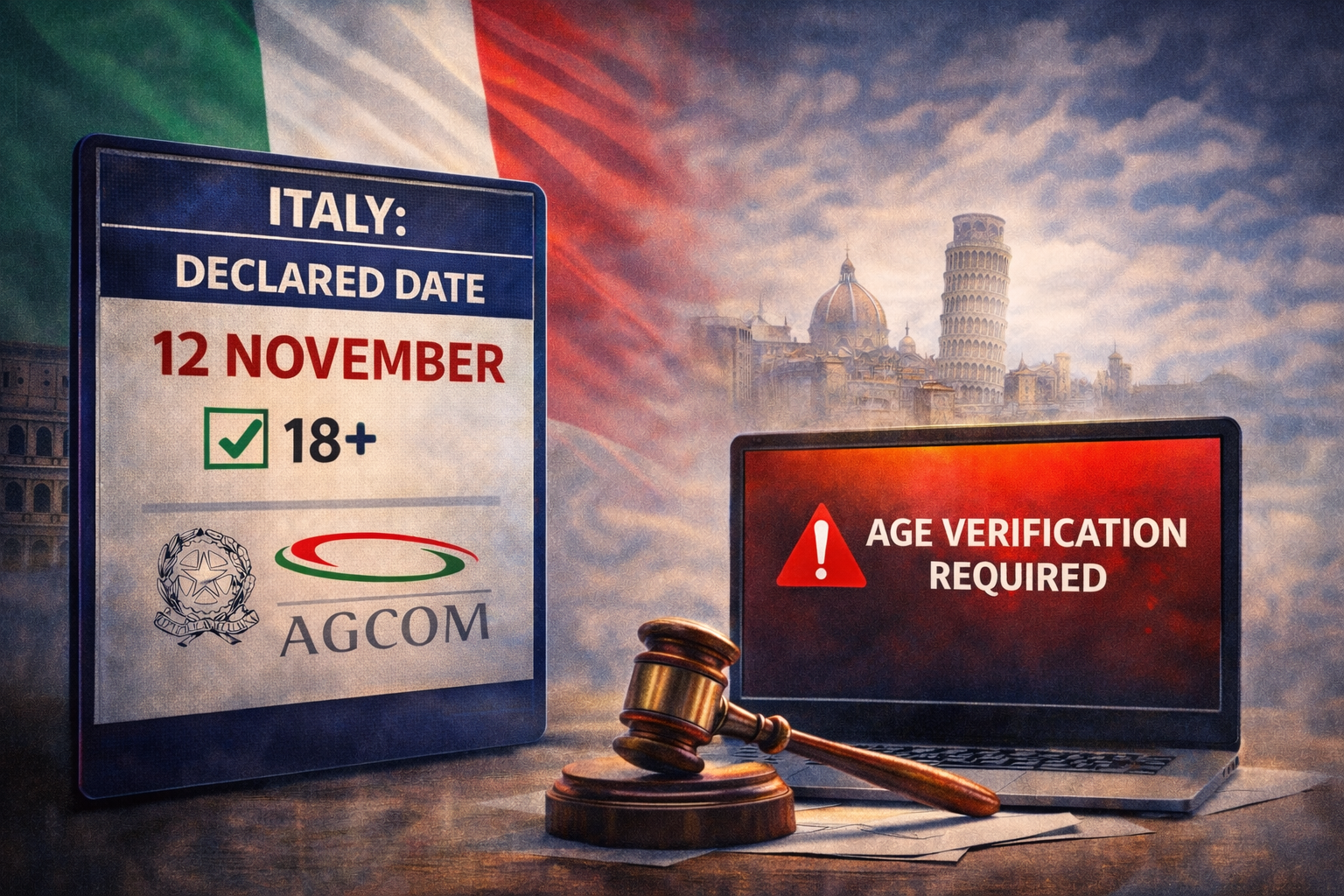
Italy’s communications regulator AGCOM has published official notices stating that age verification obligations enter into force from 12 November for sites and platforms distributing pornographic content in Italy, referencing the legal basis (the “Caivano” framework and AGCOM’s implementing regulation). [source 1][source 2][source 3]
This is the important difference between “planning” and “enforcement-ready”: Italy isn’t only debating age verification, it has a regulator-issued compliance communication, with a date, a scope and an operational expectation. [source]
Italy is therefore one of the strongest candidates to produce the same end-user experience the UK already has: no age check, no access, either because sites comply with age assurance, or because access becomes disruptable.
Spain: legislation explicitly aimed at “digital interruption” for minors’ protection
Spain is not yet at the hard-block stage for porn sites, but its policy direction is increasingly compatible with it.
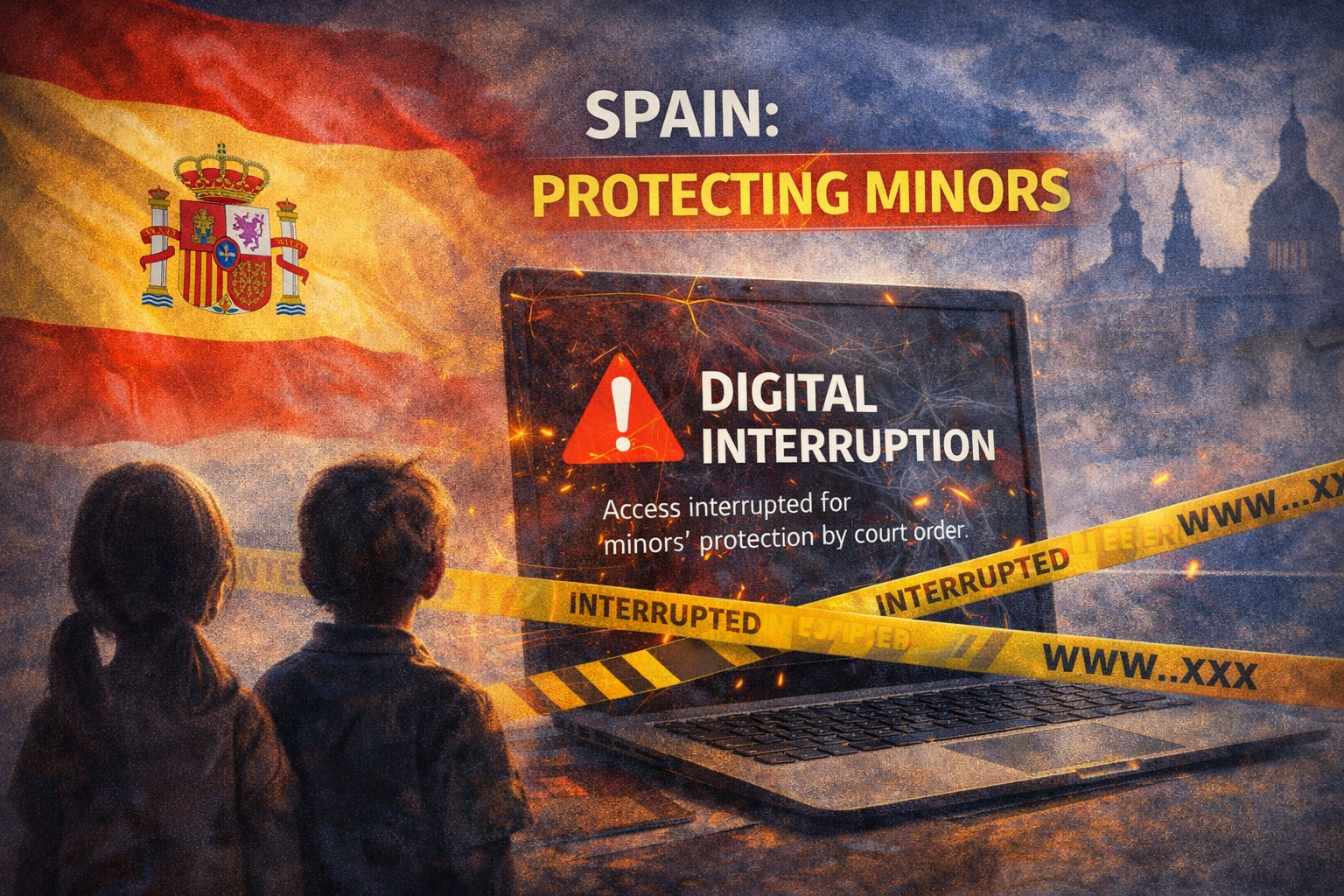
The Spanish government has publicly described draft reforms to strengthen protection of minors in the digital environment, including enabling judicial intervention for temporary interruption of a digital service offering inappropriate content to minors or requiring removal of such content. [source1][source 2]
Why this matters for porn enforcement:
• If your legal toolkit includes temporary interruption of services offering inappropriate content to minors, then the path to UK-style enforcement exists: you can escalate from rules → non-compliance → enforced interruption/blocking.
• Spain’s draft track is about building the state capacity to stop access, not only to state a norm.
Spain is the “bridge case”: less like the UK today, but structurally moving toward a regime where porn access can be controlled by enforceable measures rather than polite warnings. [source 1][source 2]
The EU layer: not a single porn law, but a continent-wide enforcement multiplier
Europe’s biggest change may not be one country copying the UK. It may be coordination.
In May 2025, the European Commission opened formal proceedings against Pornhub, Stripchat, XNXX, and XVideos under the Digital Services Act, citing suspected failures to protect minors, including inadequate age verification measures. [source 1][source 2]
This doesn’t instantly create UK-style blocking everywhere. But it changes the strategic environment: large sites face EU-level scrutiny and potential penalties, which can push them toward stronger age-gating across multiple markets rather than country-by-country friction. [source 1][source 2]
The Commission’s published DSA minors-protection guidelines recommend using effective age assurance and specifically mention restricting access to adult content such as pornography (and gambling). [source 1][source 2]
In July 2025, the Commission presented not only guidelines but also a prototype age-verification app intended to help platforms meet DSA expectations, positioned as an interim step ahead of broader EU digital identity infrastructure. [source 1][source 2]
A continent-wide tool matters because enforcement isn’t only punishment; it’s feasibility. When the EU supplies a “reference” mechanism, it reduces the argument that compliance is impossible or purely bespoke.
And the European Board for Digital Services has explicitly framed this as a coordinated enforcement environment, noting that while the Commission acts on designated very large platforms, many porn sites remain under national enforcement, which is exactly where France and Italy are sharpening their knives. [source]
If the UK is the first European country to make the adult internet feel like a guarded venue, the next likely “enforcement-stage” countries are:
• France (blocking/sanctions powers already built and activated in steps)
• Italy (explicit enforcement communications and dates for porn age verification)
• Spain (legislative moves that enable service interruption for minors’ protection, compatible with future porn enforcement)
And behind them sits the EU, not as a single porn regulator, but as a pressure system and tooling provider that makes “real enforcement” more likely to spread.
The checkbox era treated adulthood as a statement. The emerging European era treats adulthood as a credential, something you prove, like membership at the door.
This creates a new political question that goes beyond pornography: If access to adult space becomes credentialed, then the design of that credential becomes a moral issue.
France leans toward a model where you must prove you’re an adult without revealing who you are.
The UK’s model emphasizes “highly effective” assurance in multiple forms, with Ofcom setting expectations and deadlines.
The EU pushes toward standardization: the same continent that built the GDPR is now building an “age layer” for the internet.
So the story is not “Europe is banning porn.” It is subtler and, in a way, more profound: Europe is building the border.
Albania: Child Protection Progress Without Age-Gated Internet
In contrast to many Western European states moving toward enforced age-verification for online pornography, Albania currently has no legal mechanism requiring adult websites to verify the age of visitors before access. Albanian law does emphasise the protection of children and the prevention of violence and exploitation, but that emphasis has not yet translated into specific obligations on digital platforms to restrict minors’ access to pornographic content.
At the core of Albania’s domestic child-welfare framework is Law No. 18/2017 on the Rights and Protection of the Child, adopted in 2017 and reinforced through national institutions such as the State Agency for the Rights and Protection of the Child and a National Council for child protection. This law creates mechanisms for the protection and well-being of children, including institutional coordination and reporting systems, and aligns with international instruments such as the UN Convention on the Rights of the Child. It obliges authorities to monitor child rights implementation and to take protective measures against violence, abuse, and exploitation. [source 1][source 2]
Aligned with this general framework, Albanian criminal law prohibits child sexual exploitation and child pornography involving minors, imposing penalties on those who produce, distribute, or publish such material. However, the law does not establish a duty for online service providers to verify the age of users accessing adult pornography, nor does it empower a specific regulator to enforce age gates or access blocks based on age. Internet pornography remains legal to access by adults, with limitations only on content involving persons under 18; there is no equivalent provision in Albanian law mandating technical age checks for online content. [source]
Albania’s broader legal evolution shows increasing alignment with European norms on child protection. UNICEF has noted that the country has made “remarkable efforts” in recent years to build the fundamental pillars of a child protection system, including strengthening legislation and institutional capacity. However, this system remains focused on preventive and responsive interventions rather than pre-access gatekeeping for digital content. [source]
In part this reflects Albania’s status outside the European Union: while EU member states are now subject to rules like the Digital Services Act (DSA) that embed age-related risk assessments and push platforms toward age assurance, Albania does not currently face the same binding obligations. Still, as a country aspiring to deeper integration with EU structures and standards, Albania may feel indirect pressure to modernise its online safety laws in line with EU best practices, especially as EU regulators investigate major porn platforms for inadequate age verification under the DSA. [source]
Yet it’s crucial to recognise the gap between policy aspiration and legal reality. Even with growing emphasis on children’s rights and online safety, Albania has no announced timetable, draft bill, or regulator mandate for age-verification requirements on pornography websites. Any prediction that Albania will adopt such measures would be a projection based on general trends in European child protection policy rather than concrete domestic legal developments.
Thus, Albania currently represents a model where the state seeks to guard children from harm through institutional support, education, and criminal prohibitions around exploitation, rather than through restrictive technical barriers to certain classes of online content. In this sense, Albania’s digital protection landscape remains a work in progress.
For a long time, rules on the internet worked by appeal. They asked, they suggested, they relied on cooperation. Adulthood was something you declared, and the system accepted the declaration.
But boundaries that depend on honesty are not really boundaries. They are invitations.
What is emerging now is a different idea of rule-making. Not persuasion, not moral instruction, but structure. A line that does not argue, does not shame, does not explain, it simply separates.
This kind of rule does not change what people want. It changes what is possible.
Once a boundary is built into the environment, behavior adjusts around it. Not because anyone agrees, but because the path itself has changed.
That is why the current shift matters beyond pornography. It marks the moment when adulthood stops being a statement and becomes a condition of entry. Not something you say, something you must demonstrate before crossing a threshold.
The deeper question, then, is not whether a particular site is blocked or permitted. It is whether access to adult space, once credentialed, can ever return to being informal. When the border moves from the rulebook into the architecture, it rarely moves back.
Europe is not banning the room. It is quietly deciding who must prove they belong before the door opens. And once a door exists, the internet is no longer an open field. It becomes a space with edges.